When to visit Johnston Canyon, season by season
Johnston Canyon looks like two different places across the year. Winter brings ice, and summer brings loud green water. The tours change with it. Pick the season first, then the hour of the day, and the right tour almost chooses itself.
One canyon, two different places
Johnston Canyon changes so much through the year that a winter visit and a summer visit feel like separate trips. In winter the falls hang as blue and white ice. In summer the same walls drip with spray and the creek runs loud and green.
The tours follow that split. The Discover Banff icewalks run in winter, while the White Mountain Adventures e-bike and hike runs in the warm months. Which one you book depends less on taste than on when you can travel.
The canyon sits on the Bow Valley Parkway in Banff National Park, about 25 km (15 mi) from Banff town. The drive takes roughly half an hour in any season, but the conditions at the end of it do not stay the same.
Month by month at Johnston Canyon
The table gives the usual pattern. Weather in the Rockies does not follow the calendar closely, so read each row as a tendency rather than a promise.
| Months | The falls | The trail | Crowds | Tours on this site |
|---|---|---|---|---|
| December to March | Usually frozen into pillars and curtains | Packed snow and ice, cleats needed | Moderate, busier around midday | Day icewalk, evening icewalk, winter day tour |
| April and May | Thawing, part ice and part water | Slush by day, refrozen ice by morning | Lower | Check each listing's season |
| June to September | Running high, spray at the falls | Dry catwalks, queues at the viewpoints on busy days | The busiest of the year | E-bike and hike; the day tour goes to Moraine Lake instead |
| October and November | Lower water, first ice as the nights turn cold | Frosty steel in the mornings | Quieter | Check each listing's season |
The months on either side of winter are the hardest to plan. Early in December and late in March the falls can be half frozen, with water still pouring through gaps in the ice.
Winter, when the falls turn to ice
The frozen falls are the reason most people book a guided walk here. Spray and seepage build pillars and curtains of ice along the canyon walls from about December to March, in colours from deep blue to chalk white.
How much ice forms depends on the cold. A long cold spell builds big formations, while a chinook wind can bring a few mild days that soften them. The middle of winter tends to be the most reliable stretch.
Midwinter daytime highs in Banff often sit around −5 °C (23 °F), and the canyon floor gets little sun. Our guide on dressing for the icewalk covers layers and boots for that kind of cold.
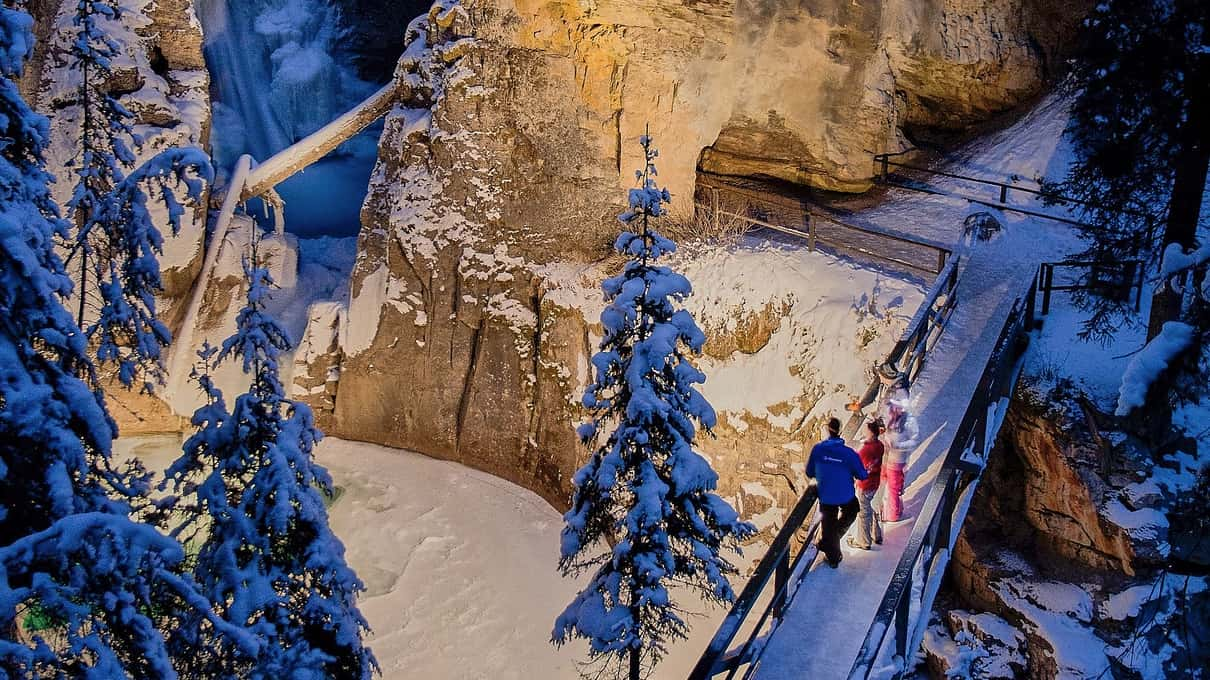
Discover Banff runs a morning or afternoon icewalk from ~$78 of about 4 hours that reaches both falls. Its evening icewalk, also from ~$78, runs for about 2.5 hours by headlamp.
Our page on choosing between day and evening weighs the two, and the frozen canyon guide explains what the ice is made of. On many cold days ice climbers work on the Upper Falls while the tours watch from the trail.
Spring thaw and the parkway rule
April and May are the awkward months. Snow on the trail turns to slush by day and refreezes overnight, so the catwalks can be wet in the afternoon and glassy in the morning.
Bring traction for your boots even when Banff town already looks like spring. The falls lose their ice in stages and can look untidy for a few weeks, though the trail is calmer and the creek starts to swell with meltwater.
Spring also brings a seasonal overnight travel restriction on part of the Bow Valley Parkway, roughly from March to late June, which gives wildlife quiet hours. Check Parks Canada's current rules before you plan a dawn or late-evening drive.
Our guide to visiting the canyon without a tour has more on parking and passes for driving there on your own.
Summer brings green water and full parking lots
From June to September the creek runs high and green, and the spray at the Lower Falls cools you after the walk in. The catwalks are dry and the forest smells of pine.
This is also when Johnston Canyon is at its busiest. It ranks among the park's most popular walks, and the parking lot can fill early on busy days. Arriving by tour or by bike takes the parking question off your hands.
That is where the White Mountain Adventures e-bike and hike, from ~$143, fits in. You ride out of Banff along the Legacy Trail and the parkway, then walk with a guide as far as the Lower Falls bridge.
A summer way into the canyon
About 4 hours from the White Mountain Adventures shop on Bear Street. The price covers the e-bike and a guide, plus a vehicle shuttle for one leg. It rates 4.8 from 240+ reviews on Viator, and riders need to reach 152 cm (5 ft) in height.
Our e-bike tour guide goes through the route stop by stop. The Rockies Journey day tour also runs in summer, but its summer route visits Moraine Lake and skips the canyon, as our Lake Louise day guide explains.
Autumn, the quiet shoulder
September and October bring cooler air and fewer people on the catwalks. Mornings can be frosty, and the steel gets slick where spray freezes overnight in the shaded parts of the gorge.
By late autumn the water drops and the first ice appears on the walls. The summer tours may have wound down before the icewalks start, so check each listing's calendar before you set your dates around a tour.
The hour matters as much as the month
Whatever the season, the canyon tends to be calmer early in the morning and toward evening. Midday usually brings the biggest crowds, as day-trippers drive out from Banff and Lake Louise.
In winter a morning or afternoon icewalk gives you daylight that shows the blue in the ice. The evening walk trades that light for headlamps, and the trail is usually less crowded after dark.
For families the timing question is also about energy. Our guide to the canyon with children looks at which slot suits small walkers, and the price comparison sets all four tours side by side.
If you can choose freely, aim for the middle of winter for the ice or early summer for the water, and take a morning slot either way.