What you see in a frozen Johnston Canyon
In summer Johnston Canyon is a loud gorge of green water. In the cold months the spray and seepage turn to ice along its walls, and the falls become columns you can stand in front of. This guide explains what you are looking at, from the rock to the ravens.
A creek that cut through limestone
Johnston Canyon is the work of Johnston Creek, which has worn a narrow slot into limestone on its way down to the Bow River. The walls rise close on both sides, and in places you can touch rock from the catwalk.
Limestone dissolves slowly in water, so the creek has carved smooth bowls and overhangs, plus a short natural tunnel near the Lower Falls. Guides on the icewalks spend time on this geology, and it makes the walk more than a stroll to two waterfalls.
The canyon sits on the Bow Valley Parkway, about 25 km (15 mi) west of Banff town. Steel catwalks are bolted to the walls, so you walk above the water rather than beside it.
How the waterfalls turn to ice
The ice does not form the way a pond freezes. Spray from the falls lands on the rock and freezes in thin layers, and water seeping out of cracks in the walls does the same, drip by drip.
Over weeks of cold those layers build up into the shapes you see from the catwalks. Icicles hang from every ledge. Seeps grow into curtains that drape down the walls, and the falls themselves thicken into pillars as wide as a house.
- Pillars form where a fall drops straight and the spray freezes around it
- Curtains form where water spreads across a slab and freezes in folds
- Icicles fringe the overhangs and the undersides of the catwalks
- Mushroom bulges grow at the foot of a fall where splash piles up
How much ice there is depends on the cold. A long frosty spell builds big formations, while a chinook thaw can soften them for a few days. Our page on the best time for Johnston Canyon covers which months usually bring the fullest ice.
Why some of the ice looks blue
The colours run from chalk white to a deep glassy blue, often within the same wall. White ice is full of tiny air bubbles that scatter light in every direction.
Dense, bubble-free ice absorbs a little of the red end of daylight, so the light that comes back to your eye looks blue. The thicker and clearer the ice, the stronger the colour, which is why the old pillars at the falls tend to glow most.
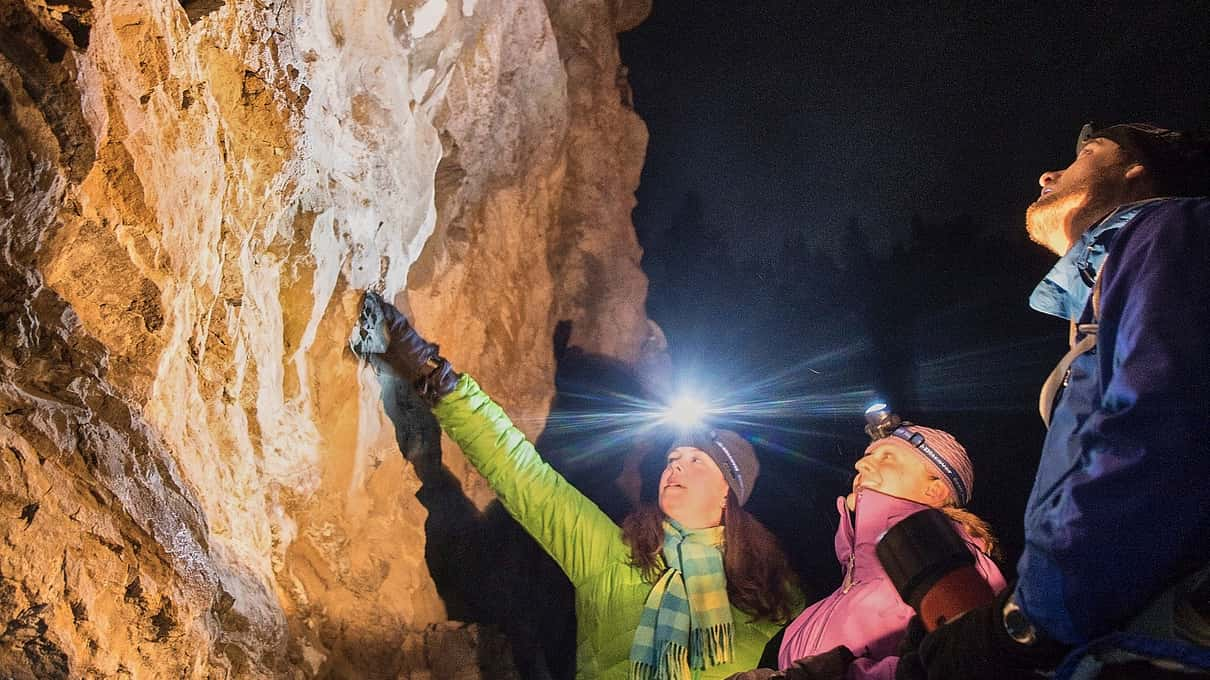
Daylight shows these shades at their best. After dark a headlamp picks out texture rather than colour, and the ice can look silver or pale green in the beam. Our comparison of daytime and evening walks goes into the light in more detail.
Ice climbers on the Upper Falls
On many winter days you will see ice climbers roped up on the frozen Upper Falls. They kick crampon points into the ice and swing tools above their heads, with a partner belaying from below.
They are not part of any tour, and there is no promise they will be there on your day. When they are, they give you a sense of scale, since a person halfway up a pillar shows how tall the frozen fall really is.
The Upper Falls sit about 2.7 km (1.7 mi) from the trailhead. Only some tours walk that far, and our guide to the Lower Falls and the Upper Falls lists which ones go where.
Water still moving under the ice
A frozen canyon is not a still one. In several spots you can hear Johnston Creek running beneath the ice, and in others you see dark open water where the current is too fast to freeze.
That is the reason the guided walks stay on the trail and the catwalks. The Discover Banff listing says its icewalks do not go onto the creek ice, and you should follow the same rule when you visit on your own.
Snow bridges over the creek can look solid and hide a hollow underneath. The catwalks give you every view you need without that risk, and ice cleats keep you upright on the packed snow of the trail.
Birds and animals that stay for the winter
Wildlife is never guaranteed, and the Discover Banff listings only ask you to keep an eye out for it. The birds are the likeliest sighting, because a few species stay in the valley all winter.
Ravens are common around the canyon and the parking lot, croaking from the treetops. You may also spot an American dipper, a small grey bird that bobs on rocks and dives into the open, fast water to feed under the surface.
In summer the canyon holds a rarer resident. Black swifts are known to nest on the damp walls behind the spray. They are rare, so you are unlikely to see one on a walk.
The canyon after dark
An evening visit turns the same ice into a different scene. Your headlamp beam lands on one icicle at a time, the rest of the gorge goes black, and the sound of the creek seems louder without the daytime crowd.
See the ice by lamplight
Discover Banff Tours' Evening Icewalk runs about 2.5 hours from ~$78, with pickup in Banff. You keep the souvenir headlamp; cleats and a pole are lent for the walk, and hot chocolate with maple cookies comes partway. Groups stay at 12 or fewer, and it scores 4.9 from 90+ reviews on Viator.
The trade-off is plain. You see only what the lamps light, the air is colder after sunset, and the listing does not say how far up the canyon the group walks. If the full Upper Falls matter most, the daytime icewalk from ~$78 is the surer choice.
Leaving the canyon as you found it
Johnston Canyon is one of the busiest trails in Banff National Park, and the ice is fragile. Stay on the catwalks and the marked path, and do not snap off icicles for a photo.
Drones are not allowed for recreational use in Canada's national parks, so leave yours in the car. Pack out every wrapper, and give the dippers space if one lands near the railing.
Warm clothes make the difference between enjoying the ice and rushing past it, so read what to wear for the icewalk before you go. Families can find age and fitness notes in Johnston Canyon with kids.